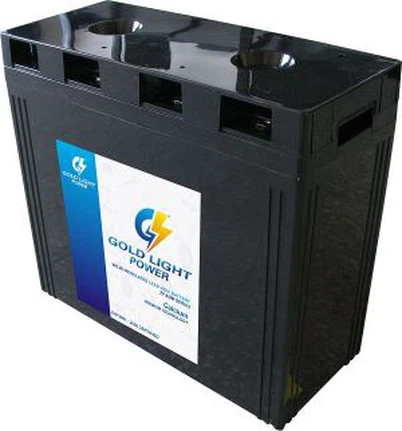
How to select the right OPzS Battery for my application?
Leave a message

Selecting the right OPzS (Opened, Pasted, tubular plate, and Sealed) battery for your application is a crucial decision that can significantly impact the performance, reliability, and cost - effectiveness of your power system. As an OPzS battery supplier, I understand the challenges that customers face in making this choice. In this blog, I will guide you through the key factors to consider when selecting an OPzS battery for your specific needs.
Understanding OPzS Batteries
OPzS batteries are a type of flooded lead - acid battery with tubular positive plates. They are known for their long service life, high reliability, and deep - cycling capabilities. These batteries are commonly used in applications such as uninterruptible power supplies (UPS), emergency power systems (EPS), and solar power storage.
The tubular plate design of OPzS batteries provides several advantages. The tubular plates are more resistant to corrosion and active material shedding compared to flat plates, which results in a longer battery life. Additionally, the design allows for better utilization of the active material, leading to higher energy density and better performance under deep - cycling conditions.
Factors to Consider When Selecting an OPzS Battery
1. Application Requirements
The first step in selecting the right OPzS battery is to understand the specific requirements of your application. Consider the following aspects:
- Power Requirements: Determine the amount of power your system needs. This includes the continuous power demand and the peak power requirements. For example, a large data center with a UPS system may require a high - capacity battery to provide backup power for an extended period during a power outage.
- Backup Time: Decide how long you need the battery to provide power in case of a power failure. This will depend on the nature of your application. For critical applications such as hospitals or telecommunications facilities, a longer backup time may be required.
- Discharge Rate: Different applications have different discharge rates. Some applications may require a high - rate discharge for a short period, while others may need a low - rate discharge over a longer time. Make sure to choose a battery that can handle the discharge rate of your application.
2. Battery Capacity
Battery capacity is measured in ampere - hours (Ah). It represents the amount of charge a battery can deliver over a specified period at a given discharge rate. When selecting an OPzS battery, choose a capacity that meets your power and backup time requirements.
For example, if your system requires a continuous power of 1000 watts and you need a backup time of 2 hours, and the battery voltage is 2 volts, you can calculate the required battery capacity. First, convert the power to amperes using the formula (P = VI) (where (P) is power, (V) is voltage, and (I) is current). So, (I=\frac{P}{V}). If (P = 1000W) and (V = 2V), (I = 500A). For a 2 - hour backup time, the required capacity is (500A\times2h=1000Ah).
We offer a range of OPzS batteries with different capacities, such as the 2V800AH OPzS Battery Flooded Lead Acid Battery That Tubular Plate UPS EPS 5years Warranty and the 2V1000AH OPzS Battery Deep Cycle Solar Power Battery VRLA Battery 20 Years Life.
3. Battery Voltage
The voltage of the battery is another important factor. OPzS batteries are typically available in 2 - volt cells. You can connect multiple cells in series to achieve the desired system voltage. For example, if your system requires a 48 - volt battery bank, you will need to connect 24 two - volt OPzS cells in series.
4. Temperature Range
The operating temperature can significantly affect the performance and life of an OPzS battery. Most OPzS batteries are designed to operate within a certain temperature range, usually between 20°C and 25°C. Extreme temperatures can reduce the battery's capacity and shorten its lifespan.
If your application is located in an area with high or low temperatures, choose a battery that can withstand the specific temperature conditions. Some batteries are designed with special features to improve their performance in extreme temperatures.
5. Maintenance Requirements
OPzS batteries are flooded lead - acid batteries, which means they require some maintenance. Regular maintenance includes checking the electrolyte level, adding distilled water if necessary, and monitoring the battery's state of charge.


However, the maintenance requirements can vary depending on the battery design and quality. Some OPzS batteries are designed for low - maintenance operation, which can save you time and effort in the long run.
6. Lifespan
The lifespan of an OPzS battery is an important consideration, especially for applications where battery replacement can be costly. The lifespan of an OPzS battery can be affected by factors such as the number of charge - discharge cycles, the depth of discharge, and the operating temperature.
On average, a well - maintained OPzS battery can last between 15 and 20 years. Our 2V1000AH OPzS Battery Deep Cycle Solar Power Battery VRLA Battery 20 Years Life is designed to provide a long service life, making it a cost - effective choice for long - term applications.
Selecting the Right Supplier
In addition to considering the above factors, choosing the right supplier is also crucial. A reliable supplier can provide you with high - quality batteries, technical support, and after - sales service.
When selecting a supplier, look for the following:
- Experience and Reputation: Choose a supplier with a good track record in the battery industry. Check customer reviews and testimonials to get an idea of their reputation.
- Product Quality: Ensure that the supplier offers high - quality OPzS batteries that meet international standards. Look for certifications such as ISO 9001, which indicates that the supplier has a quality management system in place.
- Technical Support: A good supplier should be able to provide you with technical support, including help with battery selection, installation, and maintenance.
- After - Sales Service: Consider the supplier's after - sales service, such as warranty terms, battery replacement, and repair services.
Conclusion
Selecting the right OPzS battery for your application requires careful consideration of various factors, including application requirements, battery capacity, voltage, temperature range, maintenance requirements, and lifespan. By understanding these factors and choosing a reliable supplier, you can ensure that you get a battery that meets your needs and provides long - term performance.
If you are still unsure about which OPzS battery is right for your application, or if you have any questions about our products, please feel free to contact us. We are here to help you make the best decision for your power system. Our team of experts can provide you with detailed information and guidance to ensure that you select the most suitable OPzS battery for your specific requirements. Start a conversation with us today and let's find the perfect battery solution for your application.
References
- Linden, D., & Reddy, T. B. (2002). Handbook of Batteries. McGraw - Hill.
- International Electrotechnical Commission (IEC). (2010). Secondary cells and batteries containing alkaline or other non - acid electrolytes - Portable sealed rechargeable single cells - Part 1: Nickel - cadmium. IEC 61951 - 1.