What is the voltage drop of a lead battery during discharge?
Leave a message

Hey there! As a lead battery supplier, I often get asked about all sorts of things related to lead batteries. One question that pops up quite a bit is, "What is the voltage drop of a lead battery during discharge?" Well, let's dig into this topic and break it down in a way that's easy to understand.
First off, let's talk a bit about how lead batteries work. A lead battery is made up of cells, and each cell has a certain voltage when it's fully charged. In a typical lead - acid battery, each cell has a nominal voltage of around 2 volts. When you combine these cells, you can get different total voltages for the battery, like 6 volts (3 cells), 12 volts (6 cells), and so on.
Now, when a lead battery starts to discharge, the voltage doesn't just stay constant. It gradually drops over time. This voltage drop is a natural part of the discharge process. The rate at which the voltage drops depends on a few factors.
One of the main factors is the discharge current. If you're drawing a large amount of current from the battery, the voltage will drop more quickly. Think of it like a water tank. If you have a big pipe draining the water (high current), the water level (voltage) will go down faster compared to using a small pipe (low current).
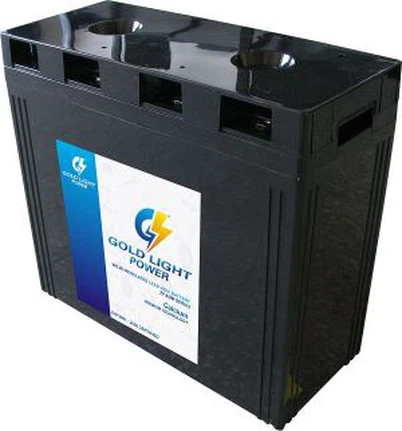
Let's say you have a 2V800AH AGM, Gel Rechargeable Battery Deep Cycle Solar Power Battery. If you're using it in a solar power system and the load is high, the voltage of this battery will drop at a relatively fast pace during discharge. On the other hand, if the load is light, the voltage drop will be more gradual.
Another factor is the state of charge (SOC) of the battery. When the battery is fully charged, the voltage is at its highest. As the battery discharges and the SOC decreases, the voltage also goes down. For example, a fully charged 12 - volt lead - acid battery might have a voltage of around 12.6 - 12.8 volts. As it discharges to 50% SOC, the voltage might drop to around 12.2 volts, and when it's almost completely discharged, the voltage can be as low as 10.5 volts or even lower.
The temperature also plays a role in the voltage drop during discharge. In cold temperatures, the chemical reactions inside the battery slow down. This means that the battery can't deliver as much power, and the voltage will drop more rapidly compared to when the battery is at a normal operating temperature. Conversely, in very hot temperatures, the battery can overheat, which can also affect the voltage and the overall performance of the battery.
Let's take a look at a practical example. Suppose you have a 2V600AH AGM Rechargeable Power Battery Valve Regulated Lead Aicd Battery for Long Life Battery that's being used in a backup power system. When the power goes out, the battery starts to discharge to power the connected devices.
If the connected devices draw a constant current of, say, 10 amps, we can expect to see a certain voltage drop over time. At the beginning of the discharge, the voltage might be around 2.1 volts per cell. As the discharge progresses, after an hour or so, the voltage might drop to 2.05 volts per cell. After a few more hours, it could reach 2 volts per cell, and as the battery gets closer to being fully discharged, the voltage will continue to drop.
It's important to monitor the voltage drop during discharge, especially in applications where a stable voltage is crucial. For example, in some electronic devices, if the voltage drops too low, it can cause the device to malfunction or even get damaged.
So, how can you deal with the voltage drop? One way is to use a battery management system (BMS). A BMS can monitor the voltage of the battery and take actions to prevent over - discharge. It can also balance the cells in the battery to ensure that all cells discharge at a similar rate, which helps to maintain a more stable overall voltage.
Another option is to use a larger capacity battery. If you have a battery with a higher amp - hour (AH) rating, it can supply power for a longer time before the voltage drops to a critical level. This is especially useful in applications where you need a continuous power supply for an extended period.
As a lead battery supplier, I understand the importance of providing high - quality batteries that can perform well under different conditions. Whether you're looking for a battery for a solar power system, a backup power system, or any other application, I can offer you a wide range of lead batteries with different capacities and specifications.


If you're in the market for a lead battery and want to learn more about how the voltage drop might affect your specific application, or if you have any other questions about lead batteries, don't hesitate to reach out. I'm here to help you make the right choice and ensure that you get the best performance from your battery. Contact me for more information and let's start a discussion about your battery needs.
References
- Battery University: A comprehensive resource on battery technology and performance.
- Various industry research papers on lead - acid battery discharge characteristics.